
A Local Expert’s Guide to Weather in Bana Hills
Are your planning a trip to the enchanting Ba Na Hills? If you’re checking the weather forecast for Da Nang and assuming it applies to the mountain, you might be in for a shock.
As local travel experts who coordinate trips up this mountain daily, we often see tourists shivering in shorts or caught off guard by sudden mists. The Ba Na Hills weather is a law unto itself. Understanding its unique microclimate isn’t just about comfort—it’s the secret to timing your Golden Bridge photos perfectly and avoiding whiteout conditions.
Why Bana Hills knowed as Fairy land or Could Kingdom?
Why is the weather so drastically different from the beaches of Da Nang just 25 kilometers away? It comes down to topography and the atmospheric lapse rate.
Ba Na Hills is perched on Mount Chua at an elevation of 1,487 meters (4,878 feet) above sea level within the Truong Son mountain range. In meteorology, temperatures drop by roughly 6.5°C for every 1,000 meters you climb. This means Ba Na Hills is consistently 7°C to 10°C (12°F to 18°F) cooler than Da Nang. Furthermore, as warm, moist air from the East Sea hits the mountain range, it is forced upward, cools, and condenses—creating the thick, swirling clouds the area is famous for.
For hot summer of the central of Vietnam, temprate about 40°C in Da Nang down town, you feel cold or cool in Bana hills tempate about 26-30 °C. How cool is!

The Reality of “Four Seasons in a Day in Bana Hills”
You will often hear that Ba Na Hills experiences four seasons in a single day. While it’s a popular marketing phrase, here is what that actually looks like on the ground:
- Morning (Spring – 7:00 AM to 10:00 AM): Crisp, cool, and often misty. The morning fog usually burns off by 9:00 AM. Pro Tip: This is the best window to photograph the Golden Bridge before the harsh midday sun and heavy crowds arrive. You can start from Da Nang from 6:30 – 7:00, then you are the first person catch cloud in the Golden Bridge.
It feels like stepping into a hidden alpine retreat. The air is intensely crisp and pure, carrying the subtle scent of damp pine needles and fresh blooms from Le Jardin D’Amour. The mountain mist leaves a cool dew on your skin, and there is a profound, echoing quietness before the main crowds arrive. Leaving the city behind in the early dawn hours allows you to watch the coastal world wake up before you ascend straight into a tranquil sea of clouds. - Midday (Summer – 11:00 AM to 2:00 PM): The clouds part, and the sun shines through. Temperatures can reach a comfortable 22°C – 25°C (71°F – 77°F). UV rays are intense at this altitude. Many activities in Sun Square, or out door activities such as: Bana Coaster Line, traditional perforceman,..
As the sun burns off the morning fog, the atmosphere instantly transforms into a vibrant European summer festival. You will feel the sudden, intense warmth of high-altitude sunlight on your skin—the perfect excuse to finally shed your jacket. The air fills with the lively sounds of carnival music, the clinking of glasses in the beer plaza, and the adrenaline-fueled cheers from the Alpine Coaster echoing across the peaks. - Late Afternoon (Autumn – 3:00 PM to 5:00 PM): The temperature drops rapidly, and quick, unexpected drizzles are common as the wind picks up across the French Village squares.
This is the most dramatic shift of the day. You will physically feel the temperature drop within minutes as a rushing, cool breeze sweeps through the stone alleyways of the French Village. The sudden chill makes pulling your fleece jacket back on feel incredibly comforting, and it’s the perfect cue to seek refuge in a warm cafe, watching the shadows lengthen over the gothic spires. - Evening (Winter – 6:00 PM onwards): Once the sun sets, temperatures plunge to 15°C (59°F) or lower. A thick, chilling fog usually blankets the mountain.
As night falls, the mountain reclaims its wild, high-altitude nature. You will likely see your breath puffing into the freezing air. The vibrant energy of the afternoon is completely replaced by an eerie, deeply romantic silence.
After a long day of walking in the cold, there is a distinct relief in taking the descending cable car down the mountain, knowing a warm, pre-arranged car is waiting at the base station to smoothly whisk you back to the comfort of your hotel.
When to Actually Visit Bana Hills
While the park is open year-round, your experience will vary wildly depending on the macro-seasons of Central Vietnam.
The Dry Season (March to August): High Visibility & Clear Skies
Average Temperature: 17°C to 25°C.
The Experience: This is objectively the best time for panoramic views and outdoor photography. You have a 90% chance of clear skies, allowing you to see all the way back to the Da Nang coastline from the Morin Station.
The Catch: Even in July, sudden 30-minute showers can occur in the afternoon due to the mountain’s moisture-trapping peaks.
If you have Chan May Shore Excusor, you should consider back earlier becausem when it is storm, the cable car have to stop from 45-60 mins.

The Wet Season (September to February): Mist, Mood, and Monsoons
Average Temperature: 10°C to 16°C (Can drop below 10°C in December/January).
Experience: The mountain lives up to its “fairy land” reputation. The French Village takes on a moody, gothic atmosphere, and walking across the Golden Bridge feels like stepping through a literal sea of clouds.
The Catch: October and November are peak typhoon months in Central Vietnam. During heavy monsoon days, visibility at the peak can drop to less than 5 meters.
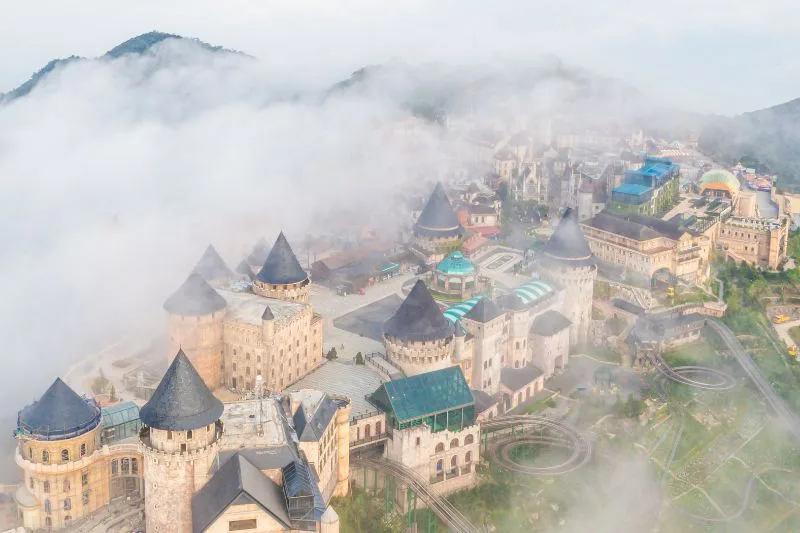
Well know for prepare perfect trip to Bana hills:
Do not let a sunny Da Nang or Hoi An morning trick you. Our guides always recommend the following:
- The 2-Layer System: Wear a breathable t-shirt (base), and carry a windproof/water-resistant shell (outer). You will take these on and off as you transition from the outdoor gardens to the indoor Fantasy Park. And avoid temprate change low in the afternoon.
- Anti-Slip Footwear: The cobblestone streets of the French Village become extremely slippery when coated in mountain mist. Leave the heels at the hotel; opt for rubber-soled sneakers or light hiking shoes.
- UV Protection: The atmosphere is thinner at 1,500m. Even on overcast days, you can easily get sunburned. Bring SPF 50+, a hat, and polarized sunglasses.
For complete planning, from choosing the right departure station to avoiding the longest queues, read our comprehensive guide on booking your [Bana hills Cable car tickets]. and WOW Pass is also VIP Services to avoid the crowed
Weather & The Cable Car System: Is it Safe?

Many travelers worry about being suspended in a glass cabin during bad weather. Yes, Cable car will be stop if it’s such as lighting, but the staff will run until last person on cable to station, some staff keep safe by keep visitor in station.
- You can rest assured: the Ba Na Hills cable car is built using world-class technology from the Austrian-Swiss manufacturer Doppelmayr. The system is designed with aerodynamic cabins that withstand significant wind shear.
- During Rain or Fog: The system operates completely normally. In fact, bursting through the thick cloud layer as you ascend from the Suoi Mo Station is one of the most thrilling parts of the journey.
- During Severe Weather: Safety protocols are strict. If wind speeds exceed safe operational limits or if there is severe lightning activity (typically during autumn typhoons), the management will temporarily suspend operations until the weather front passes.
- And your Bana tickets valid on 3 days, so you can visit Bana on next day when weather is better
Don’t let the threat of unpredictable weather deter you. Embrace the microclimate, pack a jacket, and enjoy the dramatic, ever-changing theater of Ba Na Hills.
